
Port of Seattle Opens Its 2027 Budget Season on the Eastside
Port of Seattle Opens Its 2027 Budget Season on the Eastside
Joe Fain | June 12, 2026
The Port of Seattle chose Bellevue to launch its 2027 budget planning season, and East King County showed up ready to talk. Roughly 40 mayors, city managers, finance directors, economic development leaders, and chamber executives from across the Eastside filled the fourth floor of Meydenbauer Center on Thursday morning, June 11, for the East King County Economic Outlook and Regional Investments Conversation, a breakfast hosted by the Port with its Eastside city and chamber partners and moderated by Bellevue Chamber President and CEO Joe Fain.
The format was deliberate: a short presentation, then a long conversation. Port Commissioner Sam Cho, who also serves on the Bellevue Chamber’s board, told the room the gathering was the formal start of the Port’s budget process. “Today’s conversation will directly inform the 2027 budget decisions,” Cho said. “We’re here at the start of the planning process by design.” He framed the stakes simply, and he closed with the morning’s thesis.
“The Port’s financial health reflects the region’s financial health. Strong cities and strong ports reinforce each other.” — Port Commissioner Sam Cho
The Port by the numbers
Port Chief Financial Officer Chris Wimsatt, an eight-month veteran of the Port and ACI North America’s 2024 Airport Finance Professional of the Year, walked the room through the Port’s economic footprint. Where companies like Boeing spread their impact wide and thin across the national economy, Wimsatt said, “the Port is about ten miles deep and about five feet wide,” concentrated almost entirely in this region.
The Port’s Regional Footprint
$55B
Economic output, 9.6% of King County’s total
265,000
Jobs supported, with $17.7B in wages
52.7M
Record SEA passengers, 96 domestic and 36 international nonstops
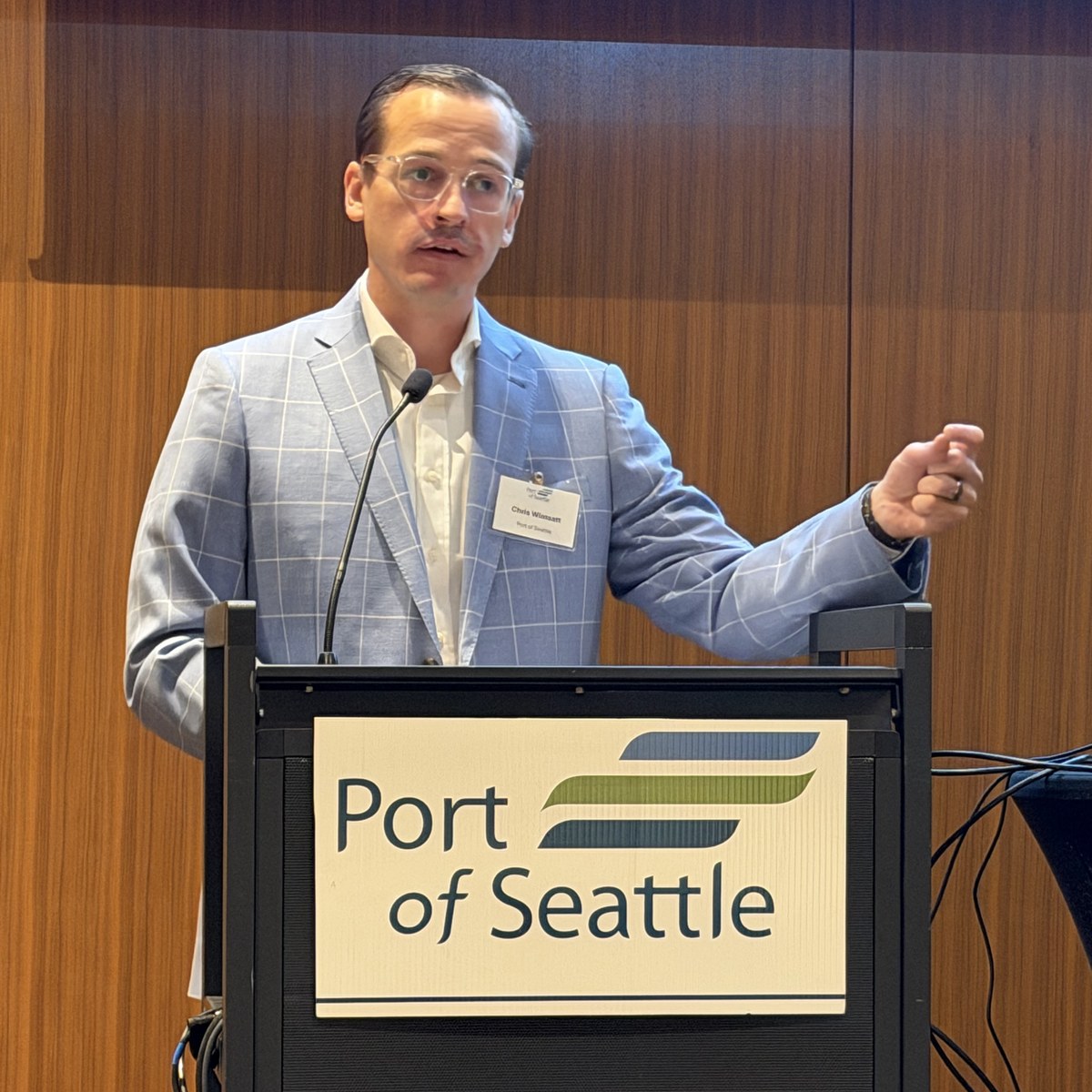
Port of Seattle CFO Chris Wimsatt walks Eastside leaders through the Port’s economic footprint and 2027 budget outlook at Meydenbauer Center.
He was candid about the constraints. Federal grant assurances wall off airport revenue from non-airport uses, the Port’s tax levy is capped by state law, and since 2021 cumulative expense growth has outpaced revenue growth, driven by the non-aviation side of the house. Cruise revenue is up 502 percent since 2021, but all other maritime revenue combined is up just 41 percent, and realigning expenses and revenues, he said, is the Port’s top budget priority.
The macro picture he painted was sober: GDP growth running below inflation, April inflation accelerating, Seattle-area CPI near 4.9 percent and rising faster than the national rate, and a bond market now pricing in potential Fed rate hikes. But none of it changes the Port’s long view. Aviation demand has recovered from every shock since the 1970s, climbing what Wimsatt called a wall of worry, and at SEA, demand already outpaces capacity.
“Our role is to catalyze regional growth and prosperity, not to serve as a bottleneck to growth. We have to be able to meet the demand that’s going to materialize whether we build for it or not.” — Chris Wimsatt, Port of Seattle CFO
The Port invested $231.6 million in communities from 2023 to 2025, including $87.2 million in programs aimed directly at cities and local economies: the Economic Development City Partnership Fund (nearly $390,000 to seven cities in 2025), workforce programs like the Maritime High School partnership, tourism grants, and sound insulation, the largest single program.
What the cities said
Fain then turned the microphones toward the tables, and a clear pattern emerged: revenues holding, expenses running away. Issaquah Mayor Mark Mullet warned colleagues not to budget on the state’s new sales tax on services, which he expects the legislature to unwind within a few years, while his sharper point was about inflation: city union contracts are pegged to the Seattle CPI, which has climbed from 3.1 percent when he took office to the 4.9 percent on Wimsatt’s slide. “For Issaquah, that’s a one million dollar a year hit,” he said, with no new services to show for it. Wimsatt agreed the math is unforgiving: costs are indexed to inflation while revenues mostly are not, and bond payments come due regardless.
Kenmore reported strong revenues overwhelmed by public safety costs rising 5 to 14 percent in each of the last five years, and its council votes next week on the city’s first levy lid lift. Bellevue’s finance team described a “bouncy” revenue picture complicated by the business and occupation (B&O) tax conversion, with a huge development pipeline “waiting for the equity markets to open up,” while Woodinville celebrated a new Trader Joe’s and the Somme Hotel and noted how much a single retailer’s arrival or departure moves a small city’s budget. Redmond and Mercer Island both pointed to light rail as a new economic force, with Mercer Island’s town center seeing a visitor uptick since the line opened in March, and Sammamish described the bedroom-community squeeze: a large population, a small commercial base, and city staffing down 20 percent. North Bend Mayor Mary Miller, whose city is about to break ground on its first hotel, offered the room its rallying cry.
“Don’t get gloomy, get creative.” — North Bend Mayor Mary Miller
Tourism, cruise, and the capacity question
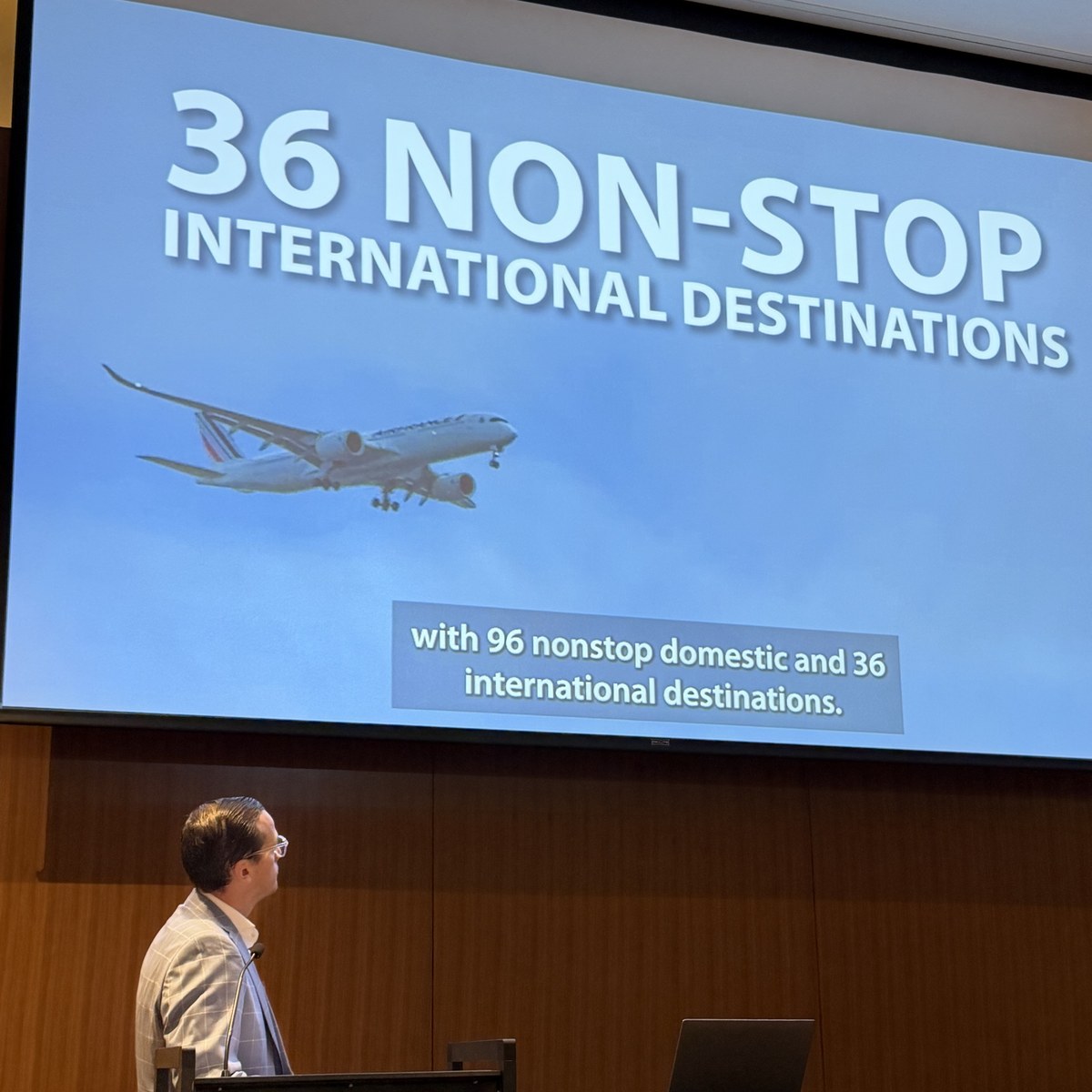
Wimsatt highlights SEA’s record reach: 96 domestic and 36 international nonstop destinations, with demand already outpacing capacity.
Visit Bellevue Executive Director Brad Jones reported hospitality revenues up about 8 percent against expenses up 15 to 18 percent, and 1,500 hotel rooms in Bellevue’s pipeline stalled by capital markets. He and the Port’s Pearse Edwards both pressed the case for a state tourism program, which Washington alone among West Coast states lacks, and a Port grant focused on South Korea has already driven a 30 percent increase in South Korean visitors, a sign of what targeted international marketing can do.
On cruise, Cho noted a record season with more than 300 Alaska sailings and asked how the Eastside could capture more of it. Jones said only about 4 percent of cruise passengers currently visit the Eastside and laid out the fix: a new cruise shuttle from Bellevue hotels to the docks, closer relationships with cruise lines, and building Eastside experiences into cruise itineraries themselves.
The most consequential exchange came on airport capacity. Mullet, who wrote in support of SEA’s planned second terminal, asked whether the Port would partner on expanded service at Paine Field, and Cho’s answer marked a shift: the Port has historically treated a second regional airport as a zero-sum threat, but “we’re now at a point where we can’t afford to grow at the rate that we’re going.”
“A greenfield airport is no longer feasible. We need to figure out a way to build at an existing airport.” — Port Commissioner Sam Cho
Cho also floated extending the Port’s remote bag-check model to Bellevue, letting Eastside travelers check luggage at the Bellevue Transit Center and ride light rail to the airport unencumbered. A Redmond economic development leader supplied the closing argument: the region’s strongest case for airport capacity is not tourism or cargo but talent, and the Port and its partners should “share the stories behind the statistics.”
What happens next
Fain closed by synthesizing the morning’s through line: capacity, whether airport gates, hotel rooms, or truck parking, is the shared bottleneck on the Eastside’s growth, and the Port “is incredibly well run and a remarkable asset to our region, and is going to need a lot of our help in the years ahead as it finds the capacity to fuel what we all thrive on here on the Eastside: the influx of capital and talent and tourism.”
The Port will circulate Wimsatt’s presentation and a summary of the feedback to all invitees, and the conversation now travels to additional stops around the region as the 2027 budget takes shape. We will keep working with the Port and our East King County partners to make sure the Eastside’s voice stays in the room.
Categories
Bellevue Chamber President & CEO Joe Fain: “In practical terms, this means taxpayers and employers from every corner of Washington would be directly subsidizing the City of Seattle’s budget.”
Read the editorial: https://lnkd.in/g-MttGZa
As we evaluate the legislation, we’re focused on affordability impacts for families and employers, whether outcomes are tangible in communities, and how the policy affects long-term budget sustainability and Washington’s competitiveness.
Chamber President & CEO Joe Fain also flagged several structural issues that need closer review, including treatment of pass-through entities, charitable deductions, a potential marriage penalty, and interactions with other state tax policies.
Read more: https://lnkd.in/g8Uv_wD4