
PLUSH Committee Urges Bellevue Planning Commission to Simplify Bel-Red Street Grid
PLUSH Committee Urges Bellevue Planning Commission to Simplify Bel-Red Street Grid
Joe Fain | April 22, 2026
The Bellevue Chamber's Permitting, Land Use, and Sustainable Housing (PLUSH) Committee submitted formal comments to the Bellevue Planning Commission ahead of the Commission's April 23 work session on the Bel-Red Subarea Code Update. The letter raises five specific concerns about proposed street grid and road width requirements that, left unchanged, could make this light-rail-served, transit-oriented development area significantly harder to build.
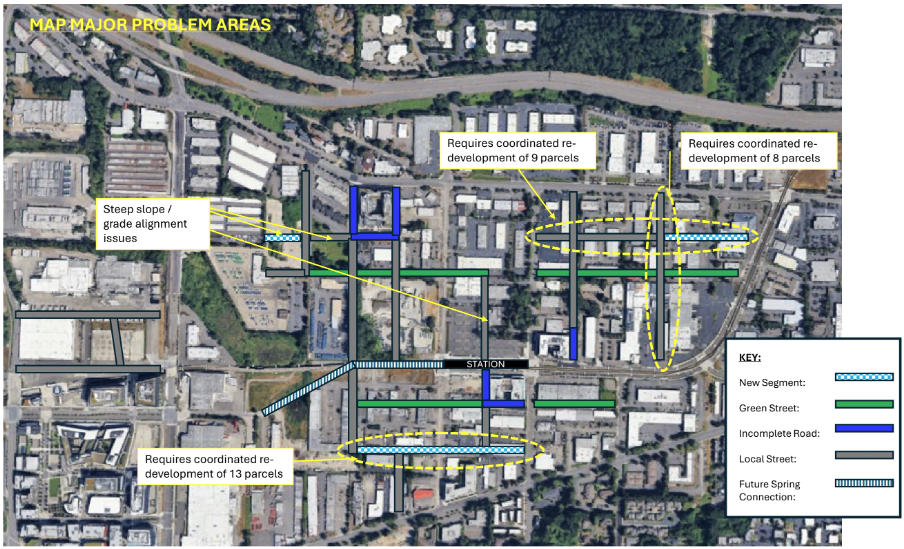
The examples above illustrate just a few of the locations where the proposed street grid creates significant feasibility challenges, driven by extreme grade changes, parcel size, and configuration
Bel-Red is one of Bellevue's most important near-term development opportunities: a transit-oriented subarea served by Sound Transit light rail and zoned for high-density mixed-use growth. The PLUSH Committee has engaged with this code update throughout the process and thanks City staff for their responsiveness. The current draft, however, carries requirements the Committee believes are inconsistent with the area's development goals and out of alignment with the code already in place for the comparable Wilburton subarea.
A 2009 Street Grid That Is Slowing Development
The City's own transportation staff have testified that the proposed mandatory street grid is not required to meet transportation needs in Bel-Red. Yet the current draft preserves a rigid grid first conceived in 2009, one that has produced minimal development in the years since precisely because of the costs and constraints it places on property owners. The code asks private landowners to build large roads that the City itself acknowledges are unnecessary. Those roads consume land that could otherwise support offices or housing. The PLUSH Committee is asking the Commission to direct staff to answer a direct question: what specific transportation purpose does the street grid serve that cannot be achieved through flexible pedestrian and bicycle connectivity standards?
In a transit-oriented development context, connectivity goals are far better served by flexible pedestrian access standards than by a mandatory network of 50- to 60-foot roadways. If the answer from staff is that the grid is primarily about walkability and block-breaking, the code should say so explicitly and the tools used should be scaled accordingly.
Why Bel-Red Should Be Held to the Same Standard as Wilburton
Bel-Red and Wilburton share the same fundamental profile: both are TOD subareas near light rail stations, both are targeted for high-density mixed-use development, and both operate under the same general planning framework. Wilburton is a higher-density zone with taller buildings and higher FARs, but its development code was built through extensive stakeholder engagement and has produced active development interest as a result. The PLUSH Committee's question is direct: why should Bel-Red face more burdensome standards?
The Committee requests that the Commission direct staff to identify every material difference between the Bel-Red draft and the Wilburton code and provide a specific policy justification for each. Absent a compelling reason for divergence, Bel-Red standards should be aligned with Wilburton.
Path Width Requirements That Push Owners Toward More Expensive Options
The Bel-Red draft includes an enhanced shared use path standard significantly more burdensome than what Wilburton requires. The proposed design, a 14-foot path flanked by 12-foot amenity strips, totals 26 feet of required corridor width with no ability to build over it. Wilburton requires a 14-foot path. That amenity strip requirement is difficult to justify in a pedestrian environment already free of vehicle traffic, and the enhanced path as currently drafted cannot serve as an emergency vehicle access route.
That structural limitation pushes property owners toward the "flexible access corridor" or 20-foot service/alley typology instead. The practical effect is that the typology intended to promote active transportation ends up being more expensive and less flexible than an alley. This is precisely the wrong incentive structure for a TOD area. The Committee recommends aligning the standard with Wilburton's 14 feet and revising the code to allow the path to qualify as an emergency access route at the property owner's discretion.
Green Streets: Width and On-Street Parking
The two proposed "green streets" in the Bel-Red code remain nearly as wide in the current draft as in the prior version: 60 feet versus 61 feet. In established planning practice, a "green street" describes an existing street retrofitted with landscaping and stormwater features to improve the pedestrian experience. It is not a newly required 60-foot road with a parking lane attached. The proposed green streets are also not continuous, which further undercuts their utility as major pedestrian corridors.
On-street parking in a transit-served TOD area works against the goal of reducing vehicle dependence. Evidence from comparable transit corridors points clearly to walkability and density, not curb-side parking, as the drivers of retail success. The Committee is asking the Commission to direct staff to eliminate the on-street parking lane requirement from the green street cross-sections and reduce the overall width to a standard more appropriate for a pedestrian-priority corridor.
Development Feasibility Is at Stake
Street grid requirements impose costs on property owners that go well beyond road construction. Grade changes required to build streets through Bel-Red's sloped terrain have already proven extraordinarily expensive for early movers in the subarea. A mandatory grid will make additional parcels either more costly to develop or, in some cases, infeasible to develop at all. That is the opposite of what an upzoned TOD area is supposed to accomplish.
The City Council's own prior direction on Bel-Red was clear: the goal is walkable connectivity, not a conventional two-lane street network with parking lanes. The PLUSH Committee is asking the Commission to hold the code to that standard and provide staff with direction to simplify and narrow the transportation requirements accordingly.
What the Chamber Is Asking For
The PLUSH Committee respectfully requests that the Planning Commission provide direction to staff on five specific items:
- Eliminate or substantially reduce the mandatory street grid and replace it with a flexible pedestrian and bicycle connectivity standard consistent with Wilburton
- Align the enhanced shared use path width with Wilburton's 14-foot standard and allow it to serve as an emergency access route where width is sufficient
- Reduce green street widths and remove the on-street parking lane requirement
- Direct staff to identify and justify all material differences between the Bel-Red draft and the Wilburton code
- Address the specific locations where the street grid as mapped would render parcels undevelopable due to physical or environmental constraints
"The Bel-Red subarea has tremendous potential as a transit-oriented community, and we remain committed to working constructively with the City to achieve a code that enables that vision." -- Joe Fain, President & CEO, Bellevue Chamber of Commerce
Read the Full Letter
Categories
Bellevue Chamber President & CEO Joe Fain: “In practical terms, this means taxpayers and employers from every corner of Washington would be directly subsidizing the City of Seattle’s budget.”
Read the editorial: https://lnkd.in/g-MttGZa
As we evaluate the legislation, we’re focused on affordability impacts for families and employers, whether outcomes are tangible in communities, and how the policy affects long-term budget sustainability and Washington’s competitiveness.
Chamber President & CEO Joe Fain also flagged several structural issues that need closer review, including treatment of pass-through entities, charitable deductions, a potential marriage penalty, and interactions with other state tax policies.
Read more: https://lnkd.in/g8Uv_wD4