
Ranking Washington
Washington Is #2 and #45 at the Same Time. Here's How.
Joe Fain | June 23, 2026
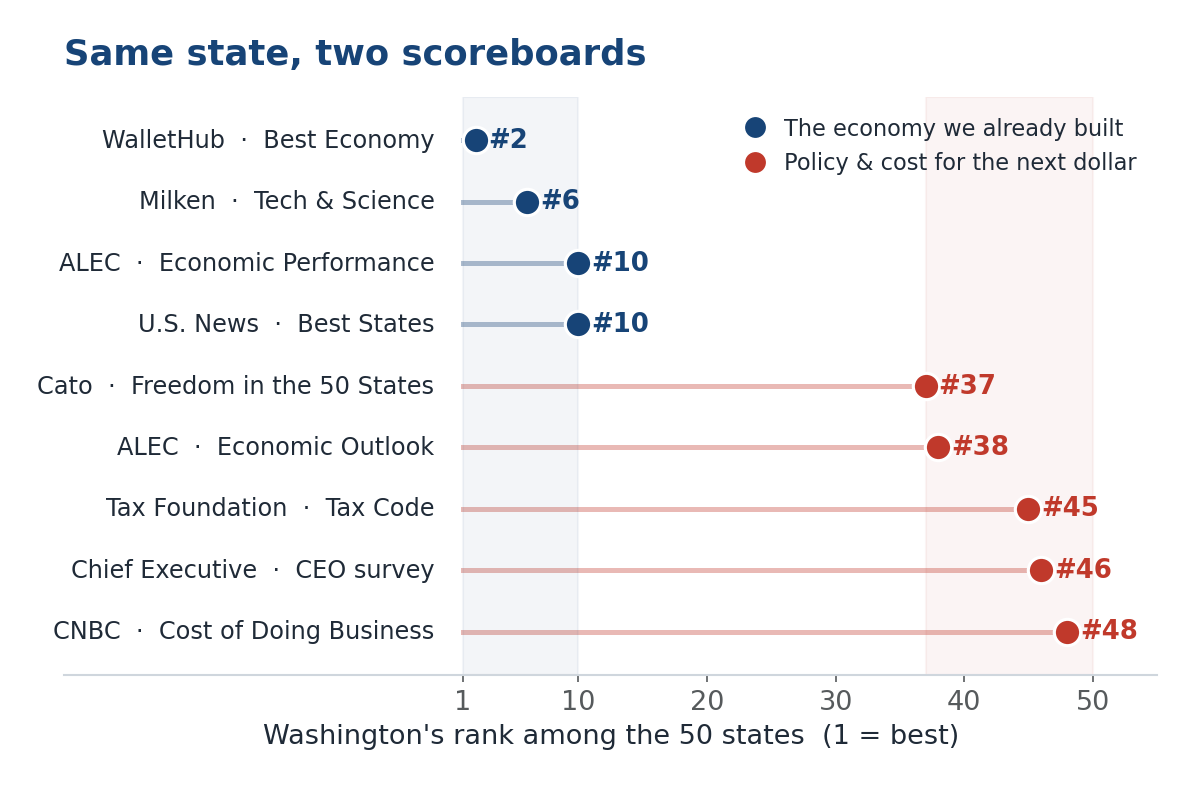
This year WalletHub named Washington the second-best economy in the nation, behind only Massachusetts. That same year, the Tax Foundation ranked Washington 45th for the competitiveness of its tax code. Both are current, and both are built on credible public data.
So, which is it? Are we a powerhouse or a problem? The honest answer is “Yes.”
That wild spread is not the economy talking, it is the methodology of each ranking. So the Bellevue Chamber built a tool to put these scoreboards in context: to add a bit more transparency to the philosophical and methodological framing of each ranking, and to draw attention to the factors each score over- or under-indexes as it paints its picture of Washington past, present, and future.

Who scores the scorers?
Line the popular economic rankings up and a pattern appears immediately. On one side are the rankings that measure the economy we already have: its size, its tech density, its accumulated research muscle, the outcomes of decisions made years ago. On those, Washington is spectacular. WalletHub has us #2. Milken’s State Technology and Science Index puts us #6 for R&D and STEM concentration. ALEC ranks our recent economic performance #10. U.S. News, weighing public services and quality of life, lands us at #8.
On the other side are the rankings that measure something different: our policy, our costs, and the climate for the next investment, the next hire, the next headquarters. On those, Washington is near the back of the room. Tax Foundation #45. ALEC’s forward-looking economic outlook #38. Cato’s Freedom in the 50 States #37. A Chief Executive survey of the leaders who actually decide where to operate, #46. CNBC’s cost-of-doing-business score, #48.
No score is the verdict
No single one of these is the verdict. Even the broadest ranking, CNBC’s America’s Top States for Business, with its 135 metrics across ten categories, is just one set of weights among many. What is worth watching is not the rank in any one year. It is the direction it moves.
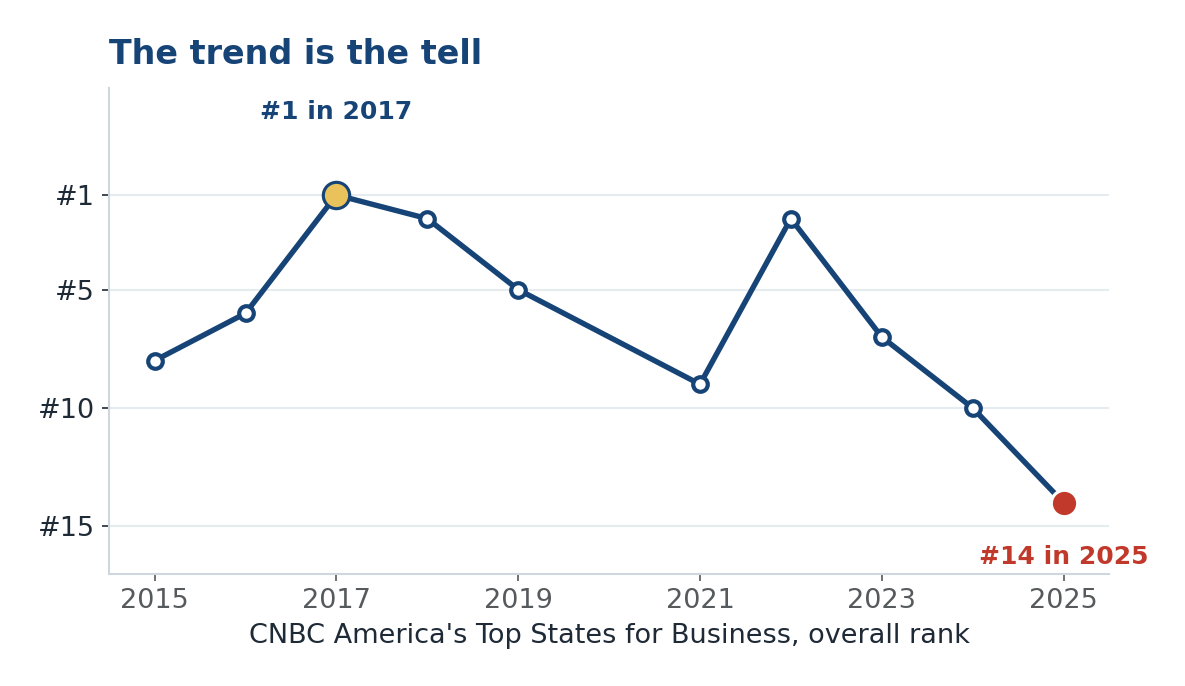
Washington came in 14th this year. Inside that number, Technology ranked #4 and the Economy #6, both excellent. Cost of Doing Business ranked #48. And the trend is the tell. We were #1 on this list in 2017. Then #2. Then #10. Now #14.
“We are #2 at having an economy and #45 at keeping one.”
It’s always about the people
The driver of our success is complicated, but one factor stands out above the rest: workforce. Our highest rankings are the ones that rightly reward us for having educated workers.
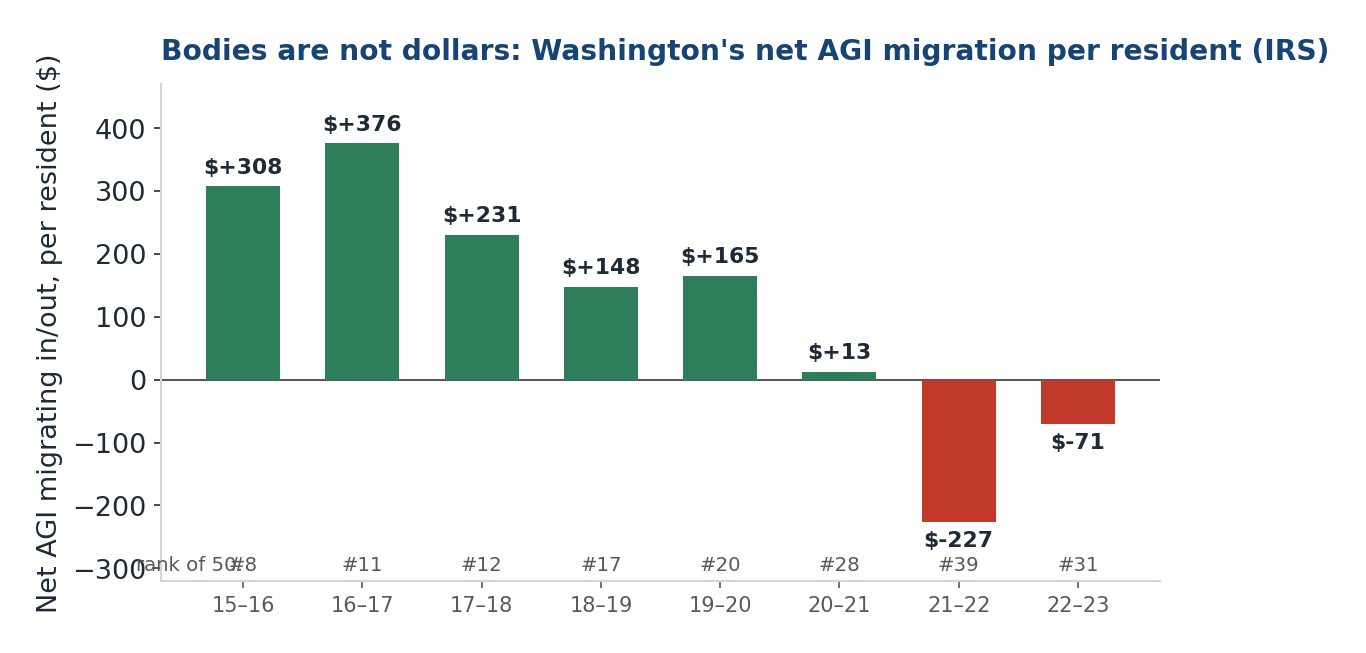
Many statistics still show our region is growing. U-Haul’s growth index ranks Washington #6 for in-migration. But U-Haul counts trucks, not incomes. Ask the IRS, which tracks the actual dollars moving in and out of the state, and the picture flips. Washington was one of 26 states that lost adjusted gross income on net in 2022-23. It lost less than most, but it is a net loss, not a gain, right as the new capital-gains tax took effect.
Census data now shows the growth we still have is carried largely by international migration. Washington has improved its talent pipeline in recent years, but it still runs a talent-import economy. We now rank near the top nationally in the share of degrees awarded in science and engineering fields, but our economy’s demand for technical talent still outstrips what we produce locally. The #2 economy is, in part, a measure of our magnetism. It is not a measure of whether a kid who graduates from a Washington high school can get in the door.
Who carries the load
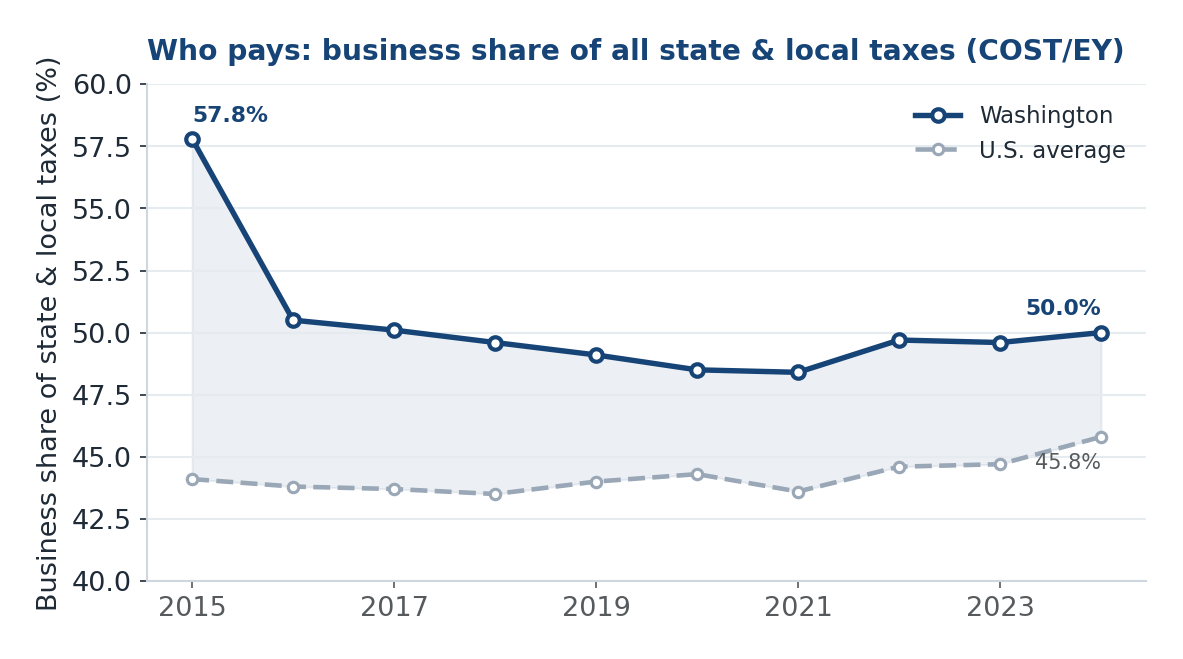
There is one more thing the rankings disagree about: who actually pays. The EY and Council On State Taxation studies show that businesses cover about half of every state and local tax dollar in Washington, above the national average in every year for a decade, largely because the Business & Occupation tax falls on gross receipts rather than on net income.
The #2 is one county
One more thing the headlines hide. Washington’s #2 economy is Seattle and the Eastside. Subtract it and what remains is a solidly middle-of-the-pack economy. That is not a knock on the rest of Washington, but a warning about concentration. Washington is not alone in the geographic concentration of its economic engine, but we are more concentrated today than at any point in recent history.
Increasingly, the assets that earn us our high rankings are also the most mobile. Tech talent recruited from elsewhere is less rooted here than the average machinist or teacher, and the high-paid jobs they hold can fold up a laptop and relocate in a way that a port, a fabrication facility, or a forest never could.
Predicting the future
If our leaders genuinely value what the good rankings measure, the innovation, the research, the talent, the headquarters, then they should treat the bad rankings as the early-warning system for losing exactly those things. The #45, the #46, and the #48 are not the opponents of the #2. They are its forecast. The Tax Foundation did not move us from #33 in 2020 to #45 today because our economy got worse. It moved us because Olympia, over recent sessions, changed the structure underneath it.
Explore the rankings yourself
We put every major ranking in one place, back to 2015, with the source and methodology behind each one. Sort them by what they measure, watch how Washington has moved on each, and ask the built-in assistant your own questions of the data.

The best way to celebrate being #2 is to understand how we got there, and to act like we want to keep it.
Categories
Bellevue Chamber President & CEO Joe Fain: “In practical terms, this means taxpayers and employers from every corner of Washington would be directly subsidizing the City of Seattle’s budget.”
Read the editorial: https://lnkd.in/g-MttGZa
As we evaluate the legislation, we’re focused on affordability impacts for families and employers, whether outcomes are tangible in communities, and how the policy affects long-term budget sustainability and Washington’s competitiveness.
Chamber President & CEO Joe Fain also flagged several structural issues that need closer review, including treatment of pass-through entities, charitable deductions, a potential marriage penalty, and interactions with other state tax policies.
Read more: https://lnkd.in/g8Uv_wD4