
Why Did Washington's Multifamily Permits Spike in Q2 2026?
Why Did Washington's Multifamily Permits Spike in Q2 2026?
Patrick Hanks | October 13, 2026
The September 2026 forecast from Washington's Economic and Revenue Forecast Council (ERFC) has an unusual data point: seasonally adjusted multifamily permits spiked in the second quarter of 2026. After the Legislature passed statewide rent stabilization (2025) and the millionaire's tax (2026), the common assumption was that capital would flee apartment development. So why did multifamily permits surge in Q2 2026?
Permits ran at an annual pace of about 32,400 multifamily units in Q2. That is up 57% from Q1 and roughly double the 2025 pace. Single-family permits barely moved.
We dug into ten years of ERFC forecasts to find out whether this is a one-off or part of a pattern. It doesn't look like a building-code rush. The timing lines up better with a federal change to affordable-housing finance, Seattle's upzoning and lower interest rates. ERFC itself expects the spike to fade by year-end.
What the numbers show
Our first question when we saw the September numbers: how can one quarter's permits be higher than the forecast for the whole year? The answer is that ERFC reports quarterly permits as a seasonally adjusted annual rate (SAAR). Each quarter is the yearly total Washington would reach if permits kept up that quarter's pace all year, after adjusting for normal seasonal swings. A Q2 rate of 32,400 means Q2 alone was running at that annual pace, while ERFC's full-year 2026 multifamily forecast averages out to about 23,400.
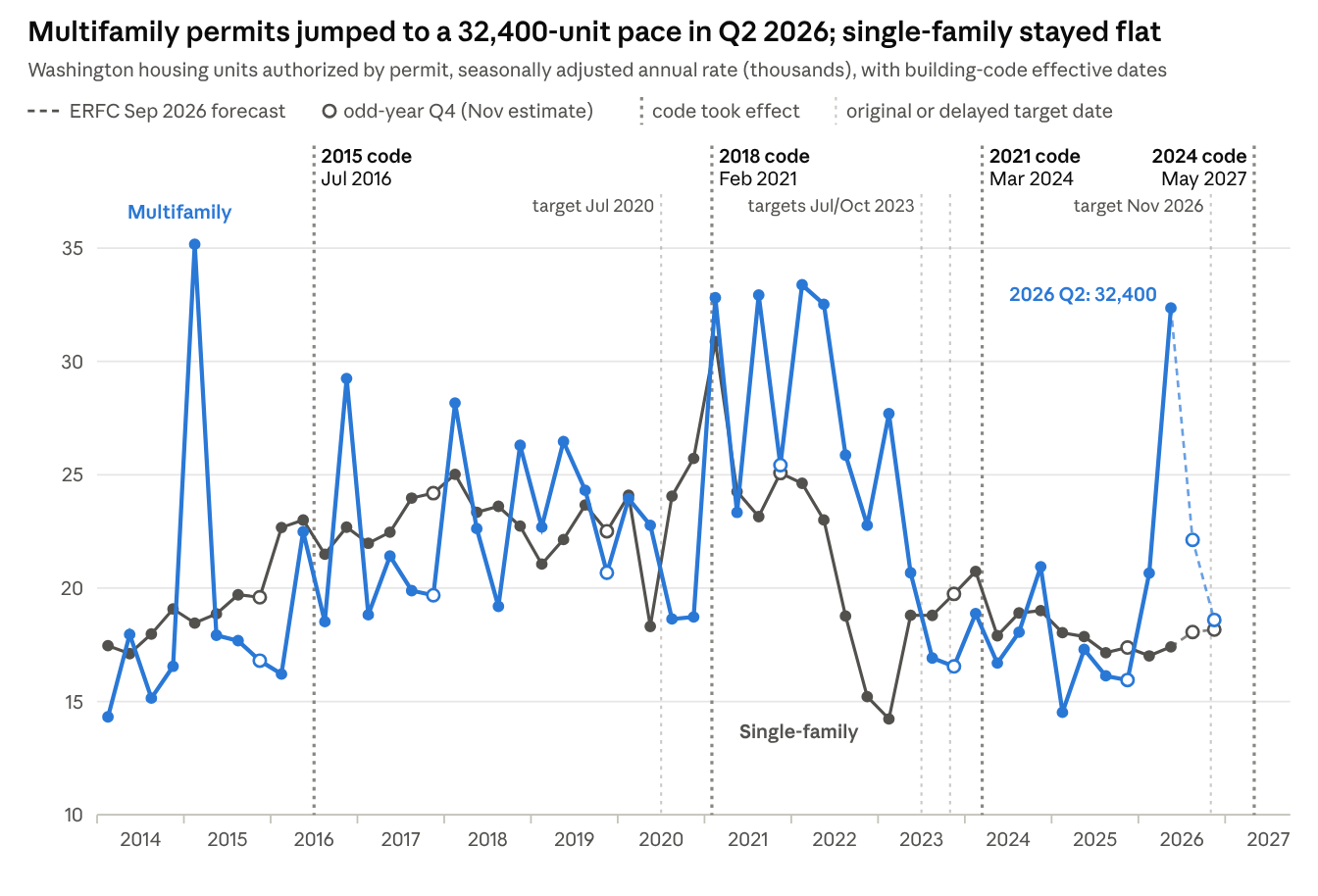
Seasonal adjustment smooths out the normal spring and summer building season, but a one-time surge still shows up. Q2 2026 is the second-largest jump in the series, behind only Q1 2015, which had no code change or obvious policy trigger.
Explore the forecasts
Every ERFC economic forecast and revenue review since 2015 is in our WA Economic & Revenue Forecast Tracker, where you can see how each report revised the forecast for multifamily permits in 2026.
Is it a building-code rush?
Next we asked whether builders were racing to get projects in before a new energy and building code. Probably not this time, though the history shows why it was worth asking.
Washington adopts new model building codes on a three-year cycle. The State Building Code Council (SBCC) usually takes about two years to amend and adopt each edition, with a July 1 effective date. Two of the last three cycles were delayed:
| Code edition | Original effective date | Actual effective date |
|---|---|---|
| 2015 | Jul 1, 2016 | Jul 1, 2016 |
| 2018 | Jul 1, 2020 | Feb 1, 2021 (COVID delay) |
| 2021 | Jul 1, 2023 | Mar 15, 2024 (delayed twice) |
| 2024 | Nov 1, 2026 | May 3, 2027 |
Under state law (RCW 19.27.095), a project vests under the code in place when its complete application is filed. For apartment buildings, the permit itself is often issued months later. That's what the data shows:
- Single-family permits rose in or just before each effective quarter: +9% in each of the two quarters before July 2016, +30% in Q1 2021, and +14% in Q1 2024.
- Multifamily spikes came one to three quarters after the effective date: +52% in Q4 2016, +32% in Q1 2021 and +25% in Q3 2021, and +25% in Q4 2024.
The Q2 2026 spike doesn't fit. It came two quarters before the 2024 code's original November 2026 date, and single-family permits didn't move. The delay to May 2027 had also been reported since September 2025 and was confirmed by an SBCC vote in January 2026. Builders had little reason to rush.
If the pattern holds, the code-related bump is still ahead of us: watch multifamily permits in late 2027 and early 2028.
What changed one to three quarters earlier?
If apartment permits tend to lag a policy change by one to three quarters, the next question is what changed between mid-2025 and early 2026. Four things stand out.
- Affordable housing finance got much easier on January 1, 2026. The federal tax law passed in July 2025 cut the share of a project that must be financed with tax-exempt bonds to qualify for the 4% Low-Income Housing Tax Credit (LIHTC) from 50% to 25%. It applies to bonds issued after December 31, 2025. The law also raised 9% credit allocations by 12% starting in 2026. Industry analysts expected bond-financed deal volume to rise by a third or more, and many developers had reason to wait until January to close. Deals closing in Q1 and pulling permits in Q2 fit the timing. These projects also tend to be large, which can produce a one-quarter spike.
- Seattle upzoned. Seattle's interim middle-housing ordinance took effect June 30, 2025. It allows at least four units on every residential lot, or six near transit or with affordable units. The City Council then adopted the One Seattle Plan on December 16, 2025, allowing three- to four-story stacked flats and removing parking requirements near frequent transit. Other cities faced similar state middle-housing (HB 1110) deadlines in mid-2025. Most of these projects are small, so this likely lifts permits gradually rather than in a single quarter.
- Interest rates came down. The Federal Reserve cut rates three times between September and December 2025. Apartment projects shelved since 2023 may have started to pencil out again, reaching the permit stage two to three quarters later.
- It's not only Washington. Multifamily permits were up 20% across the West through April 2026, and Washington's total permits for the first half of 2026 were up about 27% from a year earlier. Part of the spike reflects a broader recovery in apartment construction.
What about rent stabilization and the millionaire's tax?
The spike doesn't mean these policies have no effect. Their effects may not show up in permit data yet, for a few reasons:
- Permits reflect decisions made years ago. An apartment building can take two to four years from land purchase to permit. Many Q2 2026 permits were for projects that were financed and designed before either law passed.
- New buildings are exempt from the rent cap. HB 1217, signed May 7, 2025, caps annual increases at 7% plus inflation or 10%, whichever is lower. New buildings are exempt for 12 years after first occupancy. The bigger effect may be on buying and holding existing buildings than on new construction in the near term. Watch returns on the Real Estate Excise Tax (REET) to see if sales go down.
- The millionaire's tax hasn't started. SB 6346, signed March 30, 2026, adds a 9.9% tax on income above $1 million starting January 1, 2028. Its effect on investor decisions would show up in future permits, not necessarily ones already in the pipeline.
- Other costs went up too. The 2025 tax package raised B&O rates on many service businesses starting October 2025 and repealed the B&O deduction for interest on real-estate loans in January 2026. These push against development, not toward it.
One more policy is still ahead: the state's 2025 parking reform (SB 5184) caps required parking at half a space per unit, but larger cities have until about early 2027 to comply.
The real test of the capital-flight concern is whether the pipeline refills after this wave of projects clears. That will show up in 2027 and 2028 permits.
What it means and what to watch
The most likely explanation for the Q2 2026 spike is a wave of large, bond-financed affordable projects made possible by the January 2026 federal change, combined with lower rates and a West Coast recovery in apartment construction. Seattle's zoning changes likely add a steadier lift underneath. ERFC appears to see it as temporary too: its September forecast has multifamily permits falling back to about 22,100 in Q3 and 18,600 in Q4.
What to watch:
- Where the permits were. City-level Census permit data for Q2 2026 would show whether a few large projects in Seattle or King County drove the spike.
- Whether it repeats. If LIHTC is the driver, more bond-financed projects should follow through 2026 and 2027.
- The 2024 code. Based on past cycles, a code-related multifamily bump would appear one to three quarters after May 3, 2027.
- The pipeline after 2027. That's where any lasting effect of rent stabilization and the millionaire's tax would show.
We'll update this analysis as ERFC releases its November forecast.
Explore the data yourself
The permit figures in this analysis come from ERFC's forecasts. Our WA Economic & Revenue Forecast Tracker lines up every report since 2015, so you can watch housing permits, jobs, income and state revenue change from one forecast to the next.
About the data
Quarterly permits come from Table A1.4 of the ERFC economic forecasts, 2014 through September 2026. For each quarter, we used the latest forecast released at least one month after the quarter ended. ERFC doesn't publish Q4 history for odd-numbered years, so those quarters use the November estimate from the same year. Percent changes compare each quarter with the average of up to four quarters on either side. Actual data runs through Q2 2026; Q3 and Q4 2026 are ERFC's September preliminary forecast.
Code dates come from the State Building Code Council, Association of Washington Cities and WSR 16-03-064.
Sources
- ERFC economic forecasts
- HousingFinance: the bond financing change
- Davis Wright Tremaine: Seattle middle housing ordinance
- Housing Development Consortium: One Seattle Plan passes
- NAHB Eye on Housing: permits through April 2026
- Washington housing permits hit record high in 2026
- Stoel Rives: statewide rent stabilization
- CohnReznick: Washington millionaires' tax
- Stoel Rives: 2025 tax legislation wrap-up
- Furman Center: SB 5184
- RCW 19.27.095
Categories
Bellevue Chamber President & CEO Joe Fain: “In practical terms, this means taxpayers and employers from every corner of Washington would be directly subsidizing the City of Seattle’s budget.”
Read the editorial: https://lnkd.in/g-MttGZa
As we evaluate the legislation, we’re focused on affordability impacts for families and employers, whether outcomes are tangible in communities, and how the policy affects long-term budget sustainability and Washington’s competitiveness.
Chamber President & CEO Joe Fain also flagged several structural issues that need closer review, including treatment of pass-through entities, charitable deductions, a potential marriage penalty, and interactions with other state tax policies.
Read more: https://lnkd.in/g8Uv_wD4